I finished Italian Journey. I'm linking some of the painters he discussed in the book.
Christoph Henrich Kniep accompanied him and did some drawings for him of the places they saw. He might be considered the equivalent of "official journey photographer," except he had to draw sketches because this was before cameras. He said that Kniep lacked confidence although he was actually a good artist. It would be nice to have a copy of Goethe's book that included the drawings he did of the trip. I don't know if such a book exists. I don't even know if many of those sketches still exist.
The news of Jean-germain Drouais's death from smallpox at age 25 in 1788 "greatly distressed our artistic colony." I looked up some of his paintings and he was a good artist. The painting Goethe liked was a life-sized depiction of Philoctetes, uncompleted when he died.
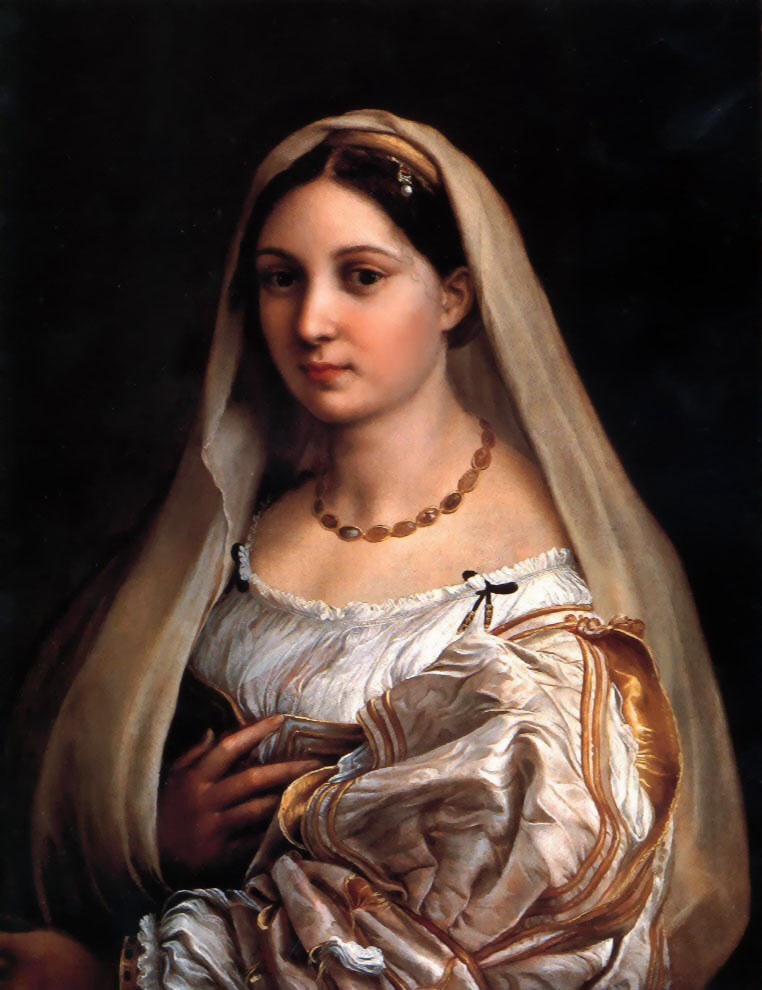
He mentions 28 paintings of the woman Raphael loved. Raphael had painted them and they were in his home. Her name was Francesco Luti and here's a portrait of her.
And he spent a lot of time with a painter named Angelica Kauffmann. He said she was always working, but never thought she did enough. Here is her self-portrait.
-------------------------------
He also mentions his poem about Hans Sachs as one he might want used at his funeral.
And a final quote from the book:
"What a disagreeable instrument the organ is! This struck me especially last night in St. Peter's, when it accompanied the choir at vespers. It does not blend with the human voice and it is much too loud."
Tuesday, October 16, 2007
Last Goethe Quote

Sunday, October 14, 2007
Goethe on Art
I didn't specifically group these; in the portion I happened to be reading tonight, it was just a coincidence that everything I happened to mark was about art. Maybe tonight's reading was heavier in the topic of art?
"What one needs to do is to look at [paintings] and then immediately look at Nature to learn what they saw in her and in one way or another imitated; then the mind is cleared of misconceptions, and in the end one arrives at a true vision of the relation between Nature and Art. I shall never rest until I know that all my ideas are derived, not from hearsay or tradition, but from my real living contact with the things themselves."
"I would say something about [a Medusa] if everything one could say about such a work were not a waste of breath. Works of art exist to be seen, not talked about, except perhaps in their presence. I am thoroughly ashamed of all the babbling about art in which I used to join."
"...I took a walk with a fellow countryman and we argued about the rival merits of Michelangelo and Raphael. I took the former's side, he the latter's, and we ended up in joint praise of Leonardo da Vinci."
About a bust of Goethe commissioned by the Prince of Waldeck and sculpted by Alexander Trippel:
"My bust has turned out exceedingly well and everybody is satisfied with it. It is executed in a noble style, and I shall have no objection if posterity imagines I looked like that."
And here is that bust:
Saturday, October 13, 2007
Goethe on Imagination, Plants, and Work
Quotes from tonight's reading of Italian Journey.
"A thousand times I have heard people complain that some object they had known only from a description was disappointing when seen in reality, and the reason was always the same. Imagination is to reality what poetry is to prose: the former will always think of objects as massive and vertical, the latter will always try to extend them horizontally."
I'm not sure I understand what he's talking about, but it certainly is food for thought.
"Let me say briefly what I think about the ancient writers and us moderns. They represented things and persons as they are in themselves, we usually represent only their substantive effect: they depicted the horror, we depict horribly; they depicted the pleasing, we pleasantly, and so on. Hence all the exaggeration, the mannerisms, the false elegance and the bombast of our age. Since, if one aims at producing effects and only effects, one thinks that one cannot make them violent enough."
Look, look! I just posted about Goethe's unifying/Primal Plant theory, and it showed up in what I read this evening!
"I must tell you confidentially that I am very close to the secret of the reproduction and organization of plants, and that it is the simplest thing imaginable. This climate offers the best possible conditions for making observations. To the main question - where the germ is hidden - I am quite certain I have found the answer; to the others I already see a general solution, and only a few points have still to be formulated more precisely. The Primal Plant is going to be the strangest creature in the world, which Nature herself shall envy me. With this model and the key to it, it will be possible to go on for ever inventing plants and know that their existence is logical; that is to say, if they do not actually exist, they could, for they are not the shadowy phantoms of a vain imagination, but possess an inner necessity and truth. The same law will be applicable to all other living organisms."
And here's an interesting defense of Naples workers, who were accused across the board of being lazy:
"...all of them work not merely to live, but to enjoy themselves: they wish even their work to be a recreation."
It sounds like us today - it's hard to imagine that such an attitude about enjoying one's work could have seemed novel at one time.
Goethe: Well, What Do You Know!
In Italian Journey, Goethe mentions his quest to find evidence that all plants came from a single plant - a unifying theory. I even quoted a comment he made where he got off on a rabbit trail in Italy when he found the native plant species to be abundant and got excited about his unification theory and wasted a day when he could have been sight-seeing because he was preoccupied chasing an unsolvable problem.
Well, here's a quote from Charlotte Mason in volume 5, [page 357] indicating that he found some measure of success in that quest:
"His scientific interests remained with him to the end. He is allowed to have been in some respects a precursor of Darwin: he it was who discovered that all plant forms are modifications of the leaf, and arrived at the certainty that there must have been an original plant from which all plants were developed."
As I understand, scientists still hope to find a single substance that everything else comes from - whether it's energy, or matter or whatever. They think that everything originally came from one thing. It's kind of an elaboration of Goethe's original idea.
Here are the two relevant quotes from Goethe's Italian Journey that I blogged a few days ago:
"To wander about among a vegetation which is new to one is pleasant and instructive. It is the same with familiar plants as with other familiar objects: in the end we cease to think about them at all. But what is seeing without thinking? Here, when I am confronted with a great variety of plants, my hypothesis that it might be possible to derive all plant forms from one original plant becomes clearer to me and more exciting. Only when we have accepted this idea will it be possible to determine genera and species exactly. So far this has, I believe, been done in a very arbitrary way. At this stage in my botanical philosophy, I have reached an impasse, and I do not yet see how to get out of it. The whole subject seems to me to be profound and of far-reaching consequence."
Berating himself for allowing himself to get side-tracked from a scenic walk in order to solve the puzzle of finding the 'promal plant' from which all other plants came:
"Why are we moderns so distracted, why do we let ourselves be challenged by problems which we can neither face nor solve?"
Wednesday, October 10, 2007
Goethe in Sicily
"Today we were shown Prince Torremuzza's collection of coins. I went there almost reluctantly. I understand too little about this field, and a merely inquisitive tourist is the bane of the true connoisseur. But, after all, one has to begin somewhere . . ."
This relates to a Prince collecting money for a charity:
"'If, I said, 'instead of spending vast sums on follies for his villa, he had used them for this cause, no prince in the world would have accomplished more.' My shopkeeper disagreed: 'Aren't we all like that? We pay gladly for our follies but we expect others to pay for our virtues.'"
Berating himself for allowing himself to get side-tracked from a scenic walk in order to solve the puzzle of finding the 'promal plant' from which all other plants came:
"Why are we moderns so distracted, why do we let ourselves be challenged by problems which we can neither face nor solve?"
"Under the shelter of an airy pergola attached to a miserable inn, we took a light midday meal. Dogs greedily gobbled up the discarded skins of our sausages; a beggar boy chased them away and hungrily consumed our apple pairings until he, in his turn, was chased away by an old beggar. Professional jealousy is to be found everywhere."
"On the higher slopes of the mountains we still found olive, carob and mountain ash. Here cultivation follows a three-year cycle - beans, corn and rest. Manure, the peasants say, works greater miracles than the saints."
And there's that word again:
"In the detritus of the river, more quartz, some plain, like breccia."

Tuesday, October 09, 2007
Goethe Visits the Hamiltons
An interesting rabbit trail in Goethe's Italian Journey--
"Sir William Hamilton, who is still living here [in Naples] as English ambassador, has now, after many years of devotion to the arts and the study of nature, found the acme of these delights in the person of an English girl of twenty with a beautiful face and a perfect figure. He has had a Greek costume made for her which becomes her extremely. Dressed in this, she lets down her hair and, with a few shawls, gives so much variety to her poses, gestures, expressions, etc., that the spectator can hardly believe his eyes. He sees what thousands of artists would have liked to express realized before him in movements and surprising transformations - standing, kneeling, sitting, reclining, serious, sad, playful, ecstatic, contrite, alluring, threatening, anxious, one pose following another without a break. She knows how to arrange the folds of her veil to match each mood, and has a hundred ways of turning it into a headdress. The old knight idolizes her and is enthusiastic about everything she does."
I was intrigued, so I looked up Sir William Hamilton to see if he'd ever been painted with his young wife, and discovered that she was famous in her own right. She was later the famed long-time mistress of Lord Horatio Nelson, had a daughter with him, and was devoted to Nelson until he died. But she squandered everything he left her and died in poverty in her fifties. She and Nelson had always pretended that the daughter was adopted (because they weren't married) and, even years and years later, the daughter herself refused to ever admit that Emma had been her mother. Emma is the subject of the Vivien Leigh/Laurence Olivier movie, That Hamilton Woman. When she so impressed Goethe, she probably presented an image similar to this painting of her:

And here's another interesting quote from the same book, Italian Journey, by Goethe.
"The storms of the last days have presented us with the picture of a magnificent sea and allowed me to study the motions and the forms of the waves. Nature is, indeed, the only book whose every page is filled with important content.
"The theatre, on the other hand, no longer gives me any pleasure . . . To me the theatre is merely a peepshow on a larger scale. I seem to have lost my taste for such things."
Saturday, October 06, 2007
A Goethe Quote About Drawing
This is another quote from Italian Journey.
"The artists like giving me lessons because I am quick to understand. But understanding is not the same as doing. Quickness of understanding is a mental faculty, but right doing requires the practice of a lifetime. However, feeble as his efforts may be, the amateur should not despair. The few lines I draw on the paper, often too hasty and seldom exact, help me to a better comprehension of physical objects. The more closely and precisely one observes particulars, the sooner one arrives at a perception of the whole. One must not, however, compare oneself with the artist, but proceed in one's own manner. Nature has provided for all her children: even the least of them is not hindered in his existence by the existence of the greatest. 'A little man is still a man.' Let's leave it at that."
I like how this parallels with Charlotte Mason's method of reproducing natural objects in drybrush as part of nature study: "The few lines I draw on the paper, often too hasty and seldom exact, help me to a better comprehension of physical objects. The more closely and precisely one observes particulars, the sooner one arrives at a perception of the whole."
The purpose of a nature notebook isn't to become a skilled artist, but in order to observe, comprehend and perceive.
Friday, October 05, 2007
More Goethe
From his book Italian Journey.
"The art of mosaic, which gave the Ancients their paved floors and the Christians the vaulted Heaven of their churches, has now been degraded to snuff boxes and bracelets. Our times are worse than we think."
Charlotte Mason tells about how Goethe grew up looking at some prints of Venice, and hearing his father talk about Italy, all his life. He had read about Italy, but hadn't yet visited it himself. The yearning to see it for himself became so strong that he had to limit what he read about Italy because it made him miserable. But now he's finally in Italy:
"My passionate desire to see these things [Italian sites] with my own eyes had grown to such a point that, if I had not taken the decision I am now acting upon [the decision to travel through Italy], I should have gone completely to pieces. More historical knowledge was no help. The things were in arm's reach [from Germany], yet I felt separated from them by an impenetrable barrier. Now I feel, not that I am seeing them for the first time, but that I am seeing them again."
"I have spent the day well, just looking and looking. It is the same in art as in life. The deeper one penetrates, the broader grows the view. In the sky of art, countless new stars keep appearing . . . "
Thursday, October 04, 2007
Goethe: Italian Journey quotes
This is a book where Goethe details his trip to Italy in the 1700's. Here are a couple of quotes.
"Looking at the noble buildings created by Palladio in this city, and noting how badly they have been defaced already by the filthy habits of men, how most of his projects were far beyond the means of his patrons, how little these precious monuments, designed by a superior mind, are in accord with the life of the average man, one realizes that it is just the same with everything else. One gets small thanks from people when one tries to improve their moral values, to give them a higher conception of themselves and a sense of the truly noble. But if one flatters the 'Birds' with lies, tells them fairy tales, caters daily to their weaknesses, then one is their man. That is why there is so much bad taste in our age. I do not say this to disparage my friends; I only say - that is what they are like, and one must not be surprised if things are as they are."
"To wander about among a vegetation which is new to one is pleasant and instructive. It is the same with familiar plants as with other familiar objects: in the end we cease to think about them at all. But what is seeing without thinking? Here, when I am confronted with a great variety of plants, my hypothesis that it might be possible to derive all plant forms from one original plant becomes clearer to me and more exciting. Only when we have accepted this idea will it be possible to determine genera and species exactly. So far this has, I believe, been done in a very arbitrary way. At this stage in my botanical philosophy, I have reached an impasse, and I do not yet see how to get out of it. The whole subject seems to me to be profound and of far-reaching consequence."
I've heard of a unifying theory that all matter is derived from a single element, but I didn't know this theory existed for plants. And I've heard of Goethe's theory about color, but I didn't know he dabbled in botanical philosophy. The more I learn about him, the more amazed I am with his mind.
Sunday, September 16, 2007
Mendelssohn and Goethe
I've been reading Volume 5 of Charlote Mason where she's talking about how Goethe's education shaped the man he later became. I'm very interested in Goethe - he was interested in everything - acoustics, music, light/color, botany, rocks and minerals, politics, literature.
I've just started reading a book that Goethe wrote when he toured Italy as a young man. The Book is called Italian Journey, and it's pretty good so far - he writes about everything - the people, the plant life, even what the gravel on the road is made of! Reviewers say that it's good introduction to Goethe, although I've read Faust and Elective Affinities (and enjoyed both), so it's not my first introduction to him. I tried to read his work on color, but it was over my head.
Mendelssohn is one of my favorite composers, so I bought a book about him a few years ago and started reading it, but never finished it - I think I got side-tracked when it went on and on about Goethe, so I read a book by Goethe and never got back to the Mendelssohn book (but I will one day soon!)
They first met in 1821, when Mendelssohn was 12 years old and Goethe was 73. The Mendelssohn family greatly admired Goethe at a time when Goethe was 'little read and a rather unpopular author.' (Probably relating to Goethe's refusal to involve himself in Germany's troubles at a time when Germany could have used his help; Charlotte Mason refers to it, but I don't know the specific details). Goethe compared their friendship to young David playing soothing music to calm old King Saul. When they first met, Goethe put him to a number of tests, including setting some unknown music in front of him all smudged, to see if he could do anything with it. It was actually an original Beethoven composition (!), and Mendelssohn not only recognized it as Beethoven because of the style, but played it on the piano, when even his music teacher, who was also there, couldn't make any sense of it! At twelve years old! Goethe, who had also met Mozart as a child, said that this meeting was similar - apparently suggesting that Mendelssohn was another Mozart.
They met a number of times. Mendelssohn once described Goethe as the 'gracious imperial sun of my life' and put two of Goethe's poems to music. Here's a quote from the Mendelssohn biography that shows how versatile Goethe was, and how varied his interests:
"What attached [Mendolssohn] to Goethe--not just Goethe's works, but to Goethe's personality--was the many-sidedness of Goethe's nature, the variety of his interests, any one of which might suddenly come to the fore in conversation. Posterity, Mendelssohn wrote, would some day assert that Goethe had not been a single person, but had consisted of a number of small Goethides: satellites revolving around a central sun, as it were. But what exactly was this central sun? At this question, Felix would fall silent, for there was something staggering about Goethe's craving for knowledge. Logical enough the talk should turn to Scotland and Spontini--these were topics on which Felix could be informative. But pretty soon Goethe had moved from these to questions of theology. What did people in Berlin think of the dispute that had just broken out between the orthodox party of Geheimrat Hengstenberg's Protestant church newspaper and the anti-Pietists Wegscheider and Gesenius? Was there serious danger of secession? No sooner had Felix replied--his own tastes were not particularly Pietistic--he tended to follow Schleiermacher who pointed out the existence of certain Greek-Pantheistic roots of Christianity--than the old man shifted to Hegel, under whom his guest had studied, after all. What, he wanted to know, did sceptical Berlin think of a man who considered himself the messianic absolute, who believed that there would be no more philosophers after him? This question was difficult to answer, and called for the utmost diplomacy. For who did not know that Goethe, with utter naivete, considered himself the 'last poet'? And none the less was astounded by Hegel's hubris...
The versatility of this mind became even more impressive when Goethe started holding forth himself. His thoughts would range from La Muette de Portici--Auber's masterpiece, which later in that year of 1830 was to stir up a revolution in Brussels--to Walter Scott, whom Felix had visited at his home in Scotland; from Scott to the pretty girls in Weimar; from the girls to the students, then to 'The Robbers,' and to Schiller. 'And now he gaily talked on for a good hour or more without interruption about Schiller's life, his writings, his position in Weimar; by way of that he came to the late Grand Duke and to the year 1775, which he called Germany's intellectual spring. Nobody would ever be able to describe all that as finely as he himself, he said. He had planned to reserve the second volume of his autobiography for that, but what with the botany and meteorolgy and all the other stuff that no one would thank him for, he never got round to it. Then he told stories about the time he was directing the theatre in Weimar, and when I tried to thank him for these reminiscences, he said: 'It's just chance, you know; all that comes to mind by the way, summoned up by your dear presence.' Those words sounded wonderfully sweet to me; it was one of those talks you don't forget for the rest of your life.'" (That last long quote, by the way, is from a letter Mendelssohn wrote about their last meeting.)
[Felix Mendelssohn and His Times by Heinrich Eduard Jacob, 1963]