My Christmas present was an Asus EEE mini-laptop. It's a computer the size of a portable DVD player. Which, of course, calls for a new purse to lug it around in. Like The Equuschick says, even though 2008 is the Year of the rat, that's no reason to be a disorganized rat.
I started with a DVD bag from Walmart and sewed on a strap good and tight. 
The side pocket (the one you're supposed to keep the DVD disks in) is the perfect size for the mini-laptop:
Which leaves the main compartment for my regular stuff - cell phone, PDA, sunglasses, etc. I threw together an organizer from cloth scraps and tacked it into the bag. I didn't want to actually sew the bag itself because one day we may want to use it for its intended purpose.
The organizer has two parts. There's a center section, padded for the PDA and cell phone, and it's tacked to the two rings on the side of the bag. And there's a flat panel made from an old sheet that folds around the center section. It's tacked to the corners of the bag into the seams so no pinholes were made in the bag itself. It has pockets for credit cards, tea bags, scissors, mirror, sunglasses and stuff. And, as an afterthought, I made a coin purse from a fabric scrap that was too pretty not to use for something.
Now all I have to do is learn Linux and I'm all set!
Saturday, December 29, 2007
New Toy, New Purse

Funny Music Video
After reading the "fishing as life" metaphor in Izaak Walton's Compleat Angler and hearing more than my share of formula songs designed to tug at the heartstrings combined with a peaceful nature setting on music videos, I especially loved Cletus Take the Reel on comedian Tim Hawkins' website. I love the moving shot of the fishing rod flying through the air. ;)
There's also a music video on the page about homeschooling, done to the tune of The Addams Family.
Saturday, December 15, 2007

Monday, December 10, 2007

Wednesday, November 28, 2007

Saturday, November 24, 2007

Thursday, November 22, 2007
We Didn't Know We Were Doing This, But This is What We're Doing

This is the social activist's (and, more recently, Christian's) response to hyper-consumerism and, more specifically, Black Friday. We've always called it "staying home and avoiding the crowds," but it actually has an official name and purpose.
Wikipedia even has a webpage about it.
Homeschooling Headed for Criminalization?
I saw this at Homeschoolbuzz.com.
So why should we in the U.S. be concerned with the plight of German homeschoolers?
I was quite surprised (yet obviously pleased) that homeschooling developed in the United States with minimal resistance from government agencies. I am even more pleased with the statistics that have emerged on the subject of home-schooled children excelling in extraordinary measure compared to their public school-attending counterparts. In truth, I rather expected a few average American families to have to endure Waco-style sieges, imprisonment and decades-long legal battles over the issue.
So, why all the hubbub over the plight of some German home schoolers?
Well, here’s why. The socialistic European model of government is where the Left in America has us gravitating toward. Read more...
Wednesday, November 21, 2007
The Strange Things You Think About While Driving
I was driving one son to basketball practice, and we passed a field of cows. They all had tags in their ears, even the little ones. I wondered if they were the same tiny calves I'd seen over the summer.
And then I wondered if, as tiny calves, they'd had any inkling that they'd have to go through the ordeal of tagging. And, even now, wandering in the field with their mothers and the other cows, nibbling a bit of grass when they get hungry, do they have any awareness of what lies ahead for them? I think these are beef cows who enjoy about a three year lifespan. All the older cows in the field will meet their fate soon, but probably have no clue about what's coming. As did last year's cows, and the cows before them, and the cows before them -- history repeats itself again and again, with the same fate for each cow, and has for probably twenty years -- more, if this is a family farm that's been going on for generations -- yet the cows are blissfully unaware of what's in store, and what happened to the generations of cows before them. Existence for a cow consists solely of the three years of its life. There's nothing before and nothing after.
But what if a cow wrote down his experiences to enlighten those who would come after? Would he warn future generations to not go into the truck, no matter much he was prodded, so as not to be led to slaughter? Would he be followed by another cow who would write, and another, so that all the generations of cows became linked with an awareness of shared experience? Would any cows read it? Would they even care? Or would they go on their merry way as long as there was green grass, blue sky, and shade to rest in?
And then I thought of a recent Common Room post, and how much our situation as humans is like the cows'. Yes, there have been some people who have expressed the deepest, most profound essence of their souls and lives, forming a link uniting generations and generations of mankind telling us that we're not alone; people have been here before us, had the same experiences, asked the same questions, attempted to find nswers, laid the foundation of knowledge in art, music, all kinds of things. But in spite of their efforts, generally, like the cows, we prefer to live in blissful unaware ignorance, as if the years of our life were the whole of existence. Nothing of importance happened before, and it's not that important what comes after. The only reality is the time we're here, like a little bubble of time that exists in isolation.
I know we don't really believe that -- sure, we "know" that famous people lived and wrote and discovered and painted. But for the most part, we don't care. It's irrelevent to our lives, and probably inferior to what we're doing today.I mean, people know the names of Blake, Rousseau, Milton, Tennyson. But how many people have actually read what they wrote? Most of us are too busy reading the latest best-seller to care about old, dusty books written by 'dead white guys.' It's the same with music. We know what's current, what's hot, and hits from twenty or thirty years ago are quaint 'oldies.' Never mind that music has been slowly evolving and saying something for hundreds of years. We feel like real music started with the birth of rock and roll.
It's amazing how your thoughts can ramble while you're driving. I wonder if cows listen to music?
Tuesday, November 20, 2007
It's Not a Yam
I've just done some research, and discovered that I've never had a yam. And I'll bet you haven't, either. In the US, they're all sweet potatoes. The softer ones are called yams, but they're still sweet potatoes. Actually, yams are African. When slaves came to the US, they thought that our sweet potatoes tasted close to what they knew as yams - and that's where the confusion began, because they started calling them yams.
Wikipedia has a whole webpage about it.
And here's a group that's dedicated to Sweet Potato Awareness, and even has a downloadable flyer to print and pass out.
I don't care what they're called, I love them. Baked, cubed and boiled, sliced and microwaved. They also taste great right out of the can.
Monday, November 19, 2007

Saturday, November 17, 2007
Stuffing Bread
This is a Thanksgiving recipe that you make in your bread machine. I wish I could credit the source, but I've tried and tried since last Thanksgiving to find the lady's website I found this on, and I haven't been able to find it. I'm wondering if the site itself disappeared.
This might be it; at least, this the recipe I changed. This might have been the site I first found it, but I'm just not positive.
Stuffing Bread
1 cup warm water
1 egg
1 Tablespoon softened margarine
2 Tablespoons brown sugar
1 1/2 teaspoons salt
1/3 cup cornbread mix
1 cup whole wheat flour
2 cups unbleached flour
2 teaspoons dried onion powder
1 1/2 teaspoons celery seed
1 teaspoon poultry seasoning
1/2 teaspoon black pepper
1 package (2 1/4 teaspoons) active dry yeast
Place everything in the bread machine in the order listed. Use basic white bread setting, 1 1/2 pound loaf size.
Thursday, November 15, 2007


Wednesday, November 14, 2007
Today's Name Is . . .
Miss M insisted on being called Harry for a week or so, then it was Electricity.
We went on vacation last week and she decided her name was Beautiful, and insisted on being introduced as such, and would only answer to that name.
That Explains It
So that's why we don't have very many readers . . .
I found this at Dewey's Treehouse, and I'm also linking this post from there to read later.
Tuesday, November 06, 2007
Feast Day

 Grace at the main table
 The toddlers' table
Despite the Renaissance theme our menu ranged far and wide, and we didn't worry much about authenticity. After last year's feast we knew we wanted to scale down, so we limited ourselves to two main dishes that we knew we could cook.
 Cooks in the kitchen
 Good, stiff mashed potatoes
The menu looked like this:
First Course (Appetizer): Homemade bread and gourmet cream of mushroom soup, right out of the Cambell's can (yeah, we kind of cheated on that one). Lemon squash from the Narnian Cookbook to drink--it's a lot like lemonade, but more bitter because it's made of a puree that includes the peel.
Second Course (Main Course): Baked ham and cottage pie, which is just like shepherd's pie--meat, vegetables, mashed potatoes, and cheese--except that it uses beef instead of mutton. To drink, ginger beer from Ingles.
Third Course (Dessert): Turkish Delight and champagne. Okay, so it was sparkling juice really, but it makes a good substitute.
As the night wore on we also had oatcakes and Halloween candy with hot cider.
We decorated the dining room with wall-hangings and curtains to cover the bookshelves and other unsightly objects (computers, CD's, you know the sort). The tableware was goblets and wooden bowls (which contributed their own flavor to the soup). We did use forks; the Locksleys had to learn how to use them, but they caught on quickly. The food was good, the feast went well, and I may say with certainty that the Locksley children had a lovely holiday.

Previous feasts: last year and the year before that.
There are more things in heaven and earth...
"A Christian...living as he does in the huge universe all ringing with the footfalls of hurrying seraphim, cherubim, archangels, angels, men, and devils, will never be too peremptory concerning what creatures aren't in on the traffic. He can only demur and say, 'Elves? I don't know much about them. I've never come across one (worse luck).'"
- Thomas Howard, Myth: Flight to Reality
(I've been reading The Christian Imagination this term--one of those happy occasions when the interests of school and inclination converge on one book. It's an excellent, inspiring anthology of Christian perspectives on art and literature; this quote is from one of the essays printed in it.)
Friday, November 02, 2007
Keeping your kids from being dumb as rocks
I saw this article posted at HomeschoolBuzz.com.
Read a provocative column recently from the SF Gate titled "American kids, dumber than dirt: Warning -- the next generation might just be the biggest pile of idiots in U.S. history." Ouch. The writer, Mark Morford, maintains -- as if none of us knew it already -- that the problem "is not bad at all. It's absolutely horrifying."
Read ten things parents can do to help here.
Sunday, October 28, 2007

Similar?
Miss M's picture reminded me of another picture of another child - it was taken almost exactly 14 years ago of another 3 year old. But that 3 year old is now 17. Where does the time go??


The Yellow Dress
This dress was given to Miss M by one of our favorite people, and we have an adorable picture of that person wearing the same dress as a toddler. So we wanted to have Miss M's picture in the dress, too. The problem is, I can't decide which picture I like best. I know that "less is more," but I have the hardest time weeding through and culling pictures of my kids.


OK, I deleted three. That was hard!
Saturday, October 27, 2007
Cleaning
On one of my message boards, there was a post about the ten germiest things in our lives - would you believe that a load of clean, wet laundry was near the top of the list? Clean laundry - it topped even public drinking fountains! That led to a search of disinfectants, which led to some websites about hydrogen peroxide, which led to more natural cleaners, with the final result that my kitchen floor is cleaner than it's been for years.
I found these sites about replacing toxic household chemicals with natural products:
http://allnaturalbeauty.us/ani12.htm
http://www.using-hydrogen-peroxide.com/
I haven't used a lot of different chemicals to begin with - some diluted bleach for disinfecting, and soapy water for almost everything else - but these ideas will help me to get things clean that weren't really getting clean before. I used a vinegar/baking soda paste on my floor with a little bit of elbow grease, and it made a big difference.
Friday, October 26, 2007

Thursday, October 25, 2007

Wednesday, October 24, 2007

My Newest Hangout
I just found this a couple of days ago. I have to watch my sugar intake, so I live vicariously by enjoying others eating stuff. This woman tries and reviews various candies on her Candy Blog. Her FAQ is interesting, she explains how she's able to work her candy samples into a balanced diet that maintains her weight and wards off diabetes. I think she tries to review one new candy a day.
Quote from Hilaire Belloc's Preface
I'm reading The Path to Rome - I was thinking it might be a useful geography text for AO Year 12, which would be nice since it's online (Goethe's isn't), but I'm not sure it will be academic enough. Belloc is a lot of fun, though, so I'm going to read it anyway.
Here's a nice quote from his preface. I've been reading aloud the funny bits to Tim. This bit isn't so much funny as it is quotable.
"Let us love one another and laugh. Time passes, and we shall soon laugh no longer--and meanwhile common living is a burden, and earnest men are at siege upon us all around. Let us suffer absurdities, for that is only to suffer one another."
Monday, October 22, 2007
Bringing up some old stuff
It's that time again - fall! Here are Tim's fall pictures although they're not from this year.
I gathered links from some of Tim's pictures and posts on our blog and put them in one easily accessible place for reference.
Friday, October 19, 2007
One of my New Hangouts
I don't keep up with news much - just enough to know the gist of what's going on in the world, but not enough to know about the latest horrific crime. On my Yahoo page, I changed my page so it shows Entertainment News instead of World News. So now I don't hear about every bomb, murder or salmonella poisoning - but I know who's getting married, having a baby or won an award. And I sleep much better.
While I was looking for something else, I stumbled onto this Celebrity Baby Blog. Pictutes of celebrities with their kids. New postings every day of the latest starlet's newborn, or famous Dad taking his toddler to the park. Very sweet.
Thursday, October 18, 2007
Movie Review Links
This is silly. I have a page for my own personal links but the only time I've used it in the last year or more is to check on movies, to see if they're family-friendly (although now we have a ClearPlay video player, so we can filter most movies!)
So I might as well have those links here. Here they are, and I'll put them in my sidebar later. I'm at my blog a lot more often than I'm at my webpage, so it'll be a lot more convenient.
Family-friendly film reviews
Charity's Place
Plugged In
Kids in Mind
I love Kids in Mind. They list every single incident that might cause offense, so their reviews look like this:
A girl calls a boy a name, and he calls her one back.
A boy kisses a girl.
A man's arm is torn off.
Kids throw food at each other.
A floor is shown with food all over it.
Two cars collide and burst into flame.
I appreciate the fact that they don't miss a thing, and I find their format of listing these things entertaining. :)
Wednesday, October 17, 2007
How's My Reading Going?
I made my own AO-ish reading schedule for two terms along with the boys' school schedules. I'm keeping up with it okay, but narrations have gone by the wayside (except for the ones from Golden Windows, because I might need synopses of each chapter to schedule specific ones later if it's used for AO).
Golden Windows is easy reading, but sometimes a little too moralistic. I think selected chapters may be useful. The nice thing about this book is that the chapters are short and not too difficult to understand, like parables From Nature.
Stories from Herodotus is boring, hard to follow, and unpleasant because it talks about wars, battle plans and cruel deeds - such as kings killing the little sons of men who disappointed them. It confirms my belief that history is nothing more than one bloodbath after another, at least political history. I much prefer to read what people ate, what kind of houses they lived in and how they parented and educated their children.
Stories from the Greek Tragedians isn't so political, but filled with lots of sad episodes. At least it's more interesting.
Scotland's Story is pretty good. Maybe I just like anything by H.E. Marshall. She has a way of adding in the kind of details I like, rather than go through one horrific war after another. After this book, I've decided to read her history of Germany. I've always wanted to know more about these places and their history, and her children's books are an enjoyable and painless way to do that.
Tuesday, October 16, 2007
Last Goethe Quote
I finished Italian Journey. I'm linking some of the painters he discussed in the book.
Christoph Henrich Kniep accompanied him and did some drawings for him of the places they saw. He might be considered the equivalent of "official journey photographer," except he had to draw sketches because this was before cameras. He said that Kniep lacked confidence although he was actually a good artist. It would be nice to have a copy of Goethe's book that included the drawings he did of the trip. I don't know if such a book exists. I don't even know if many of those sketches still exist.
The news of Jean-germain Drouais's death from smallpox at age 25 in 1788 "greatly distressed our artistic colony." I looked up some of his paintings and he was a good artist. The painting Goethe liked was a life-sized depiction of Philoctetes, uncompleted when he died.
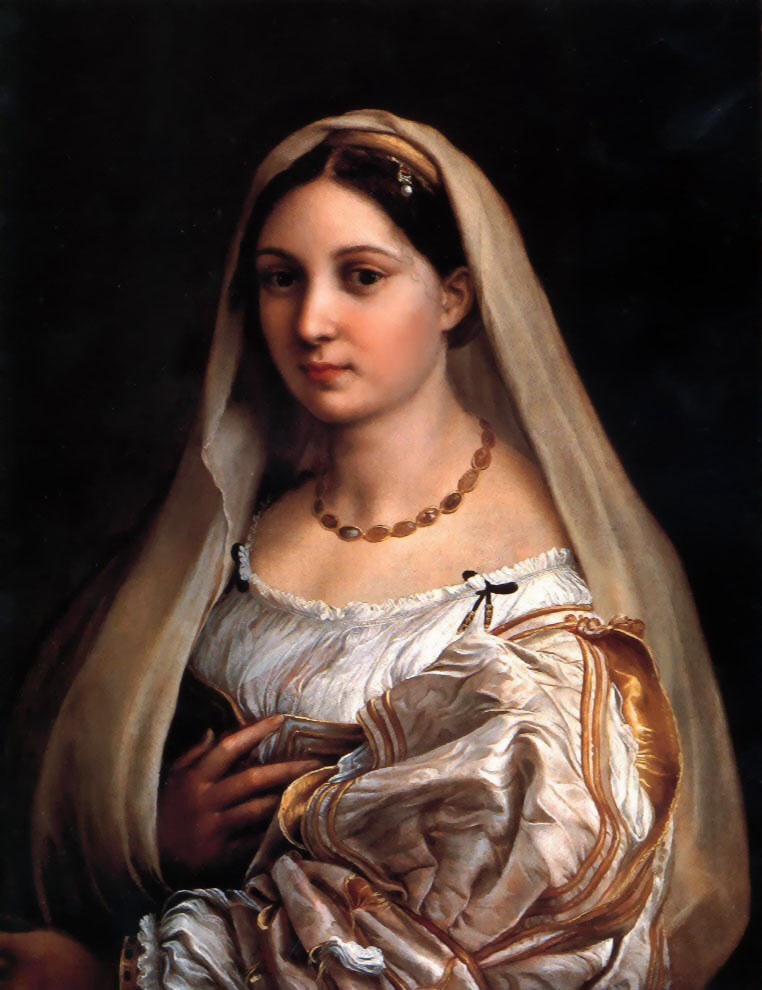
He mentions 28 paintings of the woman Raphael loved. Raphael had painted them and they were in his home. Her name was Francesco Luti and here's a portrait of her.
And he spent a lot of time with a painter named Angelica Kauffmann. He said she was always working, but never thought she did enough. Here is her self-portrait.
-------------------------------
He also mentions his poem about Hans Sachs as one he might want used at his funeral.
And a final quote from the book:
"What a disagreeable instrument the organ is! This struck me especially last night in St. Peter's, when it accompanied the choir at vespers. It does not blend with the human voice and it is much too loud."
Monday, October 15, 2007
Quotes About Books
A sampling of the quotes on this quotes page; I'd seen some of them before. These were some of the ones that were new to me:
I would be most content if my children grew up to be the kind of people who think decorating consists mostly of building enough bookshelves. ~Anna Quindlen, "Enough Bookshelves," New York Times, 7 August 1991
It is what you read when you don't have to that determines what you will be when you can't help it. ~Oscar Wilde
Books serve to show a man that those original thoughts of his aren't very new after all. ~Abraham Lincoln
Books are the bees which carry the quickening pollen from one to another mind. ~James Russell Lowell
"Tell me what you read and I'll tell you who you are" is true enough, but I'd know you better if you told me what you reread. ~François Mauriac
Books are embalmed minds. ~Bovee
Having your book turned into a movie is like seeing your oxen turned into bouillon cubes. ~John LeCarre
Sunday, October 14, 2007
Goethe on Art
I didn't specifically group these; in the portion I happened to be reading tonight, it was just a coincidence that everything I happened to mark was about art. Maybe tonight's reading was heavier in the topic of art?
"What one needs to do is to look at [paintings] and then immediately look at Nature to learn what they saw in her and in one way or another imitated; then the mind is cleared of misconceptions, and in the end one arrives at a true vision of the relation between Nature and Art. I shall never rest until I know that all my ideas are derived, not from hearsay or tradition, but from my real living contact with the things themselves."
"I would say something about [a Medusa] if everything one could say about such a work were not a waste of breath. Works of art exist to be seen, not talked about, except perhaps in their presence. I am thoroughly ashamed of all the babbling about art in which I used to join."
"...I took a walk with a fellow countryman and we argued about the rival merits of Michelangelo and Raphael. I took the former's side, he the latter's, and we ended up in joint praise of Leonardo da Vinci."
About a bust of Goethe commissioned by the Prince of Waldeck and sculpted by Alexander Trippel:
"My bust has turned out exceedingly well and everybody is satisfied with it. It is executed in a noble style, and I shall have no objection if posterity imagines I looked like that."
And here is that bust:
Miss M'isms
Miss M is almost four, but there are still some reminders that she's got a ways to grow. These are things she still says pretty regularly.
"passidy" (instead of pacifier)
"pampanks" (pancakes)
"buckle me out" when she wants out of her car seat
And these are typical--
"Turn it on wild!" (turn the water on harder.)
"When I grow up, I want to be a motorcycle lady. And I'll marry a motorcycle man and have children and their names will be Tally, etc."
"Mommy, why didn't you name me Harry when I was born? My real name's Harry." I'm not sure why she's stuck on the name Harry. Maybe she's thinking of "hairy"? She also likes to be "Lisa," but I can trace that one to Corduroy.
And she's proposed to her Daddy, all of her brothers, and her best friend, C.
Saturday, October 13, 2007
Goethe on Imagination, Plants, and Work
Quotes from tonight's reading of Italian Journey.
"A thousand times I have heard people complain that some object they had known only from a description was disappointing when seen in reality, and the reason was always the same. Imagination is to reality what poetry is to prose: the former will always think of objects as massive and vertical, the latter will always try to extend them horizontally."
I'm not sure I understand what he's talking about, but it certainly is food for thought.
"Let me say briefly what I think about the ancient writers and us moderns. They represented things and persons as they are in themselves, we usually represent only their substantive effect: they depicted the horror, we depict horribly; they depicted the pleasing, we pleasantly, and so on. Hence all the exaggeration, the mannerisms, the false elegance and the bombast of our age. Since, if one aims at producing effects and only effects, one thinks that one cannot make them violent enough."
Look, look! I just posted about Goethe's unifying/Primal Plant theory, and it showed up in what I read this evening!
"I must tell you confidentially that I am very close to the secret of the reproduction and organization of plants, and that it is the simplest thing imaginable. This climate offers the best possible conditions for making observations. To the main question - where the germ is hidden - I am quite certain I have found the answer; to the others I already see a general solution, and only a few points have still to be formulated more precisely. The Primal Plant is going to be the strangest creature in the world, which Nature herself shall envy me. With this model and the key to it, it will be possible to go on for ever inventing plants and know that their existence is logical; that is to say, if they do not actually exist, they could, for they are not the shadowy phantoms of a vain imagination, but possess an inner necessity and truth. The same law will be applicable to all other living organisms."
And here's an interesting defense of Naples workers, who were accused across the board of being lazy:
"...all of them work not merely to live, but to enjoy themselves: they wish even their work to be a recreation."
It sounds like us today - it's hard to imagine that such an attitude about enjoying one's work could have seemed novel at one time.
Goethe: Well, What Do You Know!
In Italian Journey, Goethe mentions his quest to find evidence that all plants came from a single plant - a unifying theory. I even quoted a comment he made where he got off on a rabbit trail in Italy when he found the native plant species to be abundant and got excited about his unification theory and wasted a day when he could have been sight-seeing because he was preoccupied chasing an unsolvable problem.
Well, here's a quote from Charlotte Mason in volume 5, [page 357] indicating that he found some measure of success in that quest:
"His scientific interests remained with him to the end. He is allowed to have been in some respects a precursor of Darwin: he it was who discovered that all plant forms are modifications of the leaf, and arrived at the certainty that there must have been an original plant from which all plants were developed."
As I understand, scientists still hope to find a single substance that everything else comes from - whether it's energy, or matter or whatever. They think that everything originally came from one thing. It's kind of an elaboration of Goethe's original idea.
Here are the two relevant quotes from Goethe's Italian Journey that I blogged a few days ago:
"To wander about among a vegetation which is new to one is pleasant and instructive. It is the same with familiar plants as with other familiar objects: in the end we cease to think about them at all. But what is seeing without thinking? Here, when I am confronted with a great variety of plants, my hypothesis that it might be possible to derive all plant forms from one original plant becomes clearer to me and more exciting. Only when we have accepted this idea will it be possible to determine genera and species exactly. So far this has, I believe, been done in a very arbitrary way. At this stage in my botanical philosophy, I have reached an impasse, and I do not yet see how to get out of it. The whole subject seems to me to be profound and of far-reaching consequence."
Berating himself for allowing himself to get side-tracked from a scenic walk in order to solve the puzzle of finding the 'promal plant' from which all other plants came:
"Why are we moderns so distracted, why do we let ourselves be challenged by problems which we can neither face nor solve?"
UK: Bullies driving thousands of pupils to study at home
If you ask Americans why they homeschool, you'll get reasons like religious training, higher standard of academics, better student-teacher ratio, more positive role modeling of socialization.
In the UK, a common reason is bullying. Bullying is a problem in the US, but often considered a strengthening experience for kids to work through; it seems to be looked on as a good way for kids to "learn to get along in the world" and stand on their own two feet, and is therefore a positive reason for choosing public school. I mean, you hear of a child being homeschooled because of a bully every once in a while, but it's the least common factor, at least from what I hear of the homeschoolers I know of. For bullying to be the most oft-cited motivating factor for pulling kids out of school, it must be pretty bad in the UK.
Read more here. I found this article at HomeschoolBuzz.
Thursday, October 11, 2007
Nursing Blankets
I'm not quite sure how to post this, so I'll post a link to the picture directly from its location on somebody's blog.
Wednesday, October 10, 2007
Goethe in Sicily
"Today we were shown Prince Torremuzza's collection of coins. I went there almost reluctantly. I understand too little about this field, and a merely inquisitive tourist is the bane of the true connoisseur. But, after all, one has to begin somewhere . . ."
This relates to a Prince collecting money for a charity:
"'If, I said, 'instead of spending vast sums on follies for his villa, he had used them for this cause, no prince in the world would have accomplished more.' My shopkeeper disagreed: 'Aren't we all like that? We pay gladly for our follies but we expect others to pay for our virtues.'"
Berating himself for allowing himself to get side-tracked from a scenic walk in order to solve the puzzle of finding the 'promal plant' from which all other plants came:
"Why are we moderns so distracted, why do we let ourselves be challenged by problems which we can neither face nor solve?"
"Under the shelter of an airy pergola attached to a miserable inn, we took a light midday meal. Dogs greedily gobbled up the discarded skins of our sausages; a beggar boy chased them away and hungrily consumed our apple pairings until he, in his turn, was chased away by an old beggar. Professional jealousy is to be found everywhere."
"On the higher slopes of the mountains we still found olive, carob and mountain ash. Here cultivation follows a three-year cycle - beans, corn and rest. Manure, the peasants say, works greater miracles than the saints."
And there's that word again:
"In the detritus of the river, more quartz, some plain, like breccia."

Caring for Your Introvert
I found this article while looking for tips on writing college entrance essays. I looked for one thing and found another.
"Remember, someone you know, respect, and interact with every day is an introvert, and you are probably driving this person nuts. It pays to learn the warning signs."
Tuesday, October 09, 2007
Goethe Visits the Hamiltons
An interesting rabbit trail in Goethe's Italian Journey--
"Sir William Hamilton, who is still living here [in Naples] as English ambassador, has now, after many years of devotion to the arts and the study of nature, found the acme of these delights in the person of an English girl of twenty with a beautiful face and a perfect figure. He has had a Greek costume made for her which becomes her extremely. Dressed in this, she lets down her hair and, with a few shawls, gives so much variety to her poses, gestures, expressions, etc., that the spectator can hardly believe his eyes. He sees what thousands of artists would have liked to express realized before him in movements and surprising transformations - standing, kneeling, sitting, reclining, serious, sad, playful, ecstatic, contrite, alluring, threatening, anxious, one pose following another without a break. She knows how to arrange the folds of her veil to match each mood, and has a hundred ways of turning it into a headdress. The old knight idolizes her and is enthusiastic about everything she does."
I was intrigued, so I looked up Sir William Hamilton to see if he'd ever been painted with his young wife, and discovered that she was famous in her own right. She was later the famed long-time mistress of Lord Horatio Nelson, had a daughter with him, and was devoted to Nelson until he died. But she squandered everything he left her and died in poverty in her fifties. She and Nelson had always pretended that the daughter was adopted (because they weren't married) and, even years and years later, the daughter herself refused to ever admit that Emma had been her mother. Emma is the subject of the Vivien Leigh/Laurence Olivier movie, That Hamilton Woman. When she so impressed Goethe, she probably presented an image similar to this painting of her:

And here's another interesting quote from the same book, Italian Journey, by Goethe.
"The storms of the last days have presented us with the picture of a magnificent sea and allowed me to study the motions and the forms of the waves. Nature is, indeed, the only book whose every page is filled with important content.
"The theatre, on the other hand, no longer gives me any pleasure . . . To me the theatre is merely a peepshow on a larger scale. I seem to have lost my taste for such things."
Monday, October 08, 2007
Spanish Living/Classic Books?
I'm going to start trying to collecting some classic and living Spanish booklists for a friend. who has a really cute picture of Miss M playing with her little girl on her blog.
This is only the start (I hope - not only are these not so easy to find, but I'm less familiar with Spanish books to know whether a booklist is worthy or not!)
UPDATE: Javamom has posted some Spanish language helps, including Spanish songs, poems and etexts, on her blog here and here. You can view all of her posts on Spanish Lessons here.
http://educandoenfamilia.com/ General homeschool site
They also have a message board (although it's not very active)
and an active blog Educando en Familia
When I do a search for great Spanish writers, these are some names that come up. I have no idea whether their works are worthy of a CM education.
Cervantes, Lope de Vega, Quevedo, Pio Baroja.
Wikipedia has an entry on Spanish literature. "In the Romanticism (principle of the 19th century) important topics are: the poetry of José de Espronceda and other poets; the prose, that can have several forms (the historical novel, the scientific prose, the description of regional customs, the journalism —where Mariano José de Larra can be mentioned—); the theater, with Ángel de Saavedra (Duke of Rivas), José Zorrilla, and other authors. In the latter romanticism (post-romanticism) some appear: Gustavo Adolfo Bécquer and Rosalía de Castro. " Some names offered:
18th century:
Benito Jeronimo Feijoo, Jose Cadalso, Juan Meléndez Valdés, Félix María de Samaniego, Leandro Fernández de Moratín.
19th century:
Duque de Rivas, Mariano José de Larra, Ramón de Mesonero Romanos, Gustavo Adolfo Bécquer (Rhymes, Legends), José de Espronceda (El estudiante de Salamanca, La canción del pirata), José Zorrilla (Don Juan Tenorio)
They have a more extensive list of writers from the realist and modern periods, but I don't know how those would be at instilling the kind of character Charlotte Mason had in mind - so much of modern literature has a different goal, and hispanic literature might even have its own focus altogether.
Wikipedia has a list of Spanish authors divided by country. But, again, I don't know what the quality of their works is, and how usable they'd be in a Christian-based education. I'm suspecting that a person looking for a classic books education would have to rely heavily on world classics translated into Spanish. I know they're widely available. For starters, I'm sure Aesop's fables, Fairy Tales are available in Spanish translations - even the English versions are translated from a language other than English. The standard literary classics that seem to make it on everybody's booklists (Swiss Family Robinson, Jungle Book, Little Women) must surely be available in Spanish.
I guess one solution for coming up with a Spanish version of a great books list would be for someone who knows both English and Spanish to convert a list of standard great books (perhaps starting with Ambleside Online's list) into Spanish by finding the titles in Spanish.
-----------------
I found this at the Online Books Page - book sites in foreign languages. These are Spanish etext sites:
- Biblioteca Electronica Cristiana (Christian electronic texts in Spanish)
- Biblioteca Virtual de CLACSO (social science books in Spanish)
- Biblioteca Virtual Miguel De Cervantes (Spanish texts; JavaScript-dependent)
- Comedia Library (Hispanic classical theater texts)
- Elaleph (Spanish-language PDF texts)
- Memoria Chilena (Chilean historical books and other materials in Spanish)
- Textos Lemir (medieval Spanish texts)
Here's a beginning list, thanks to Mama Squirrel's comments.
Imitacion de Cristo por Tomás Hermerken de Kempis
Poesia por Fray Luis de Léon (not sure of the quality, but the text is listed on a Christian site)
Mujercitas por LouisaMay Alcott
Desiring God by John Piper pdf file
El Progreso del Peregrino por Juan Bunyan pdf
Vintage Books online in various translations at The Rosetta Project, including Aladdin, Jack and the Beanstalk, The Three Bears, (click on the "Spanish" button for the translated text)
.
Saturday, October 06, 2007
A Goethe Quote About Drawing
This is another quote from Italian Journey.
"The artists like giving me lessons because I am quick to understand. But understanding is not the same as doing. Quickness of understanding is a mental faculty, but right doing requires the practice of a lifetime. However, feeble as his efforts may be, the amateur should not despair. The few lines I draw on the paper, often too hasty and seldom exact, help me to a better comprehension of physical objects. The more closely and precisely one observes particulars, the sooner one arrives at a perception of the whole. One must not, however, compare oneself with the artist, but proceed in one's own manner. Nature has provided for all her children: even the least of them is not hindered in his existence by the existence of the greatest. 'A little man is still a man.' Let's leave it at that."
I like how this parallels with Charlotte Mason's method of reproducing natural objects in drybrush as part of nature study: "The few lines I draw on the paper, often too hasty and seldom exact, help me to a better comprehension of physical objects. The more closely and precisely one observes particulars, the sooner one arrives at a perception of the whole."
The purpose of a nature notebook isn't to become a skilled artist, but in order to observe, comprehend and perceive.
An Abhorrent System
I'm posting this for Tim. It's about beauty and art from a blog about music.
And here's an article about New St Andrew's.
Homeschoolers Qualifying for the National Merit Scholarship program
Found on HomeschoolBuzz.com. This is from an article in the Washington Times:
"...Home-schooling has developed an impressive track record. In particular, home-schoolers are consistently achieving in the arena skeptics believe should be out of the range of average parents, which is preparing students for college.
If parents can successfully prepare children for college, then the rationale for heavily subsidizing public schools weakens significantly. Recent results from ACT show home-schoolers have scored above the national average for the past 10 years, which helps show that home-schoolers are well-prepared for college.
But there's another program in which home-schoolers are making their presence known — the National Merit Scholarship Program.The NMS program has seen a dramatic increase in the number of home-schoolers who place as finalists. Of the 248 home-schoolers among the 2003 semifinalists, 129 of these students advanced to finalist standing, receiving the National Merit Scholarship.
As noted by Kate Grossman, a reporter with the Chicago Sun-Times, the number of home-schoolers receiving National Merit Scholarships has increased more than 500 percent: from 21 in 1995 to 129 in 2003. Recently NMS announced that for 2008 there are 237 home-school semifinalists..."
Read more here.
Now I Can Read On My Treadmill!
I haven't been on my treadmill for awhile - months. First, I stopped because of leg cramps. Now that isn't as much of an issue, but I'm so busy and I need to have something to do while I'm on there. I usually watch a DVD for 30 minutes or so - we've seen the Pride and Prejudice miniseries in 30 minute installments more times than I can count, as well as episodes of All Creatures Great and Small, Christy and The Waltons. But it's hard to justify the loss of productive time every single day to watch movies. If only I could read on the treadmill . . . but the book holder I have attaches to the bar on the side of the treadmill with a screw thing, and constantly looking to one side to read is hard on the neck, plus the bouncing motion makes it hard to focus.
Finally I hit on an idea of removing the book holder from the screw-on post, and tying it onto the treadmill with a long shoestring. It rests on the dash so that it covers the digital display, but that can be seen by lifting the book. It seems to work well, the bouncing is lessened, and I can see the book straight ahead instead of to one side. Now my treadmill time isn't just wasted video time, it's productive reading time.
I think this is going to change my life.
Friday, October 05, 2007
More Goethe
From his book Italian Journey.
"The art of mosaic, which gave the Ancients their paved floors and the Christians the vaulted Heaven of their churches, has now been degraded to snuff boxes and bracelets. Our times are worse than we think."
Charlotte Mason tells about how Goethe grew up looking at some prints of Venice, and hearing his father talk about Italy, all his life. He had read about Italy, but hadn't yet visited it himself. The yearning to see it for himself became so strong that he had to limit what he read about Italy because it made him miserable. But now he's finally in Italy:
"My passionate desire to see these things [Italian sites] with my own eyes had grown to such a point that, if I had not taken the decision I am now acting upon [the decision to travel through Italy], I should have gone completely to pieces. More historical knowledge was no help. The things were in arm's reach [from Germany], yet I felt separated from them by an impenetrable barrier. Now I feel, not that I am seeing them for the first time, but that I am seeing them again."
"I have spent the day well, just looking and looking. It is the same in art as in life. The deeper one penetrates, the broader grows the view. In the sky of art, countless new stars keep appearing . . . "
Home schooling improves academic performance and reduces impact of socio-economic factors
From Mama Squirrel's blog. This is quoted from an article at The Fraser Institute, which writes about "competitive market solutions for public policy problems."
------------------------
<>Home schooling appears to improve the academic performance of children from families with low levels of education, according to a report on home schooling released today by independent research organization The Fraser Institute...
“Poorly educated parents who choose to teach their children at home produce better academic results for their children than public schools do. One study we reviewed found that students taught at home by mothers who never finished high school scored a full 55 percentage points higher than public school students from families with comparable education levels.”...
The study also reports that students educated at home outperform their peers on most academic tests and are involved in a broad mix of social activities outside the home.
Research shows that almost 25 per cent of home schooled students in the United States perform one or more grades above their age-level peers in public and private schools. Grades 1 to 4 home school students perform one grade level higher than their public- and private-school peers. By Grade 8, the average home schooled student performs four grade levels above the national average.
...a growing body of new research also calls into question the belief that home schooled children are not adequately socialized...
Our Furniture Store Discovery
During our few days in Orlando, we passed by this little building a few times; you can see it right off the freeway:

Of course, the boys were curious to see what such a place might be like on the inside, so on our way out of Orlando, we stopped and went in. It turned out to be a highlight of our trip. The place is like a museum. They sell furniture and art for homes looking for that unique touch. I think it's all reproductions; everything is massive. The paintings are handpainted and signed copies of famous art. I'm just going to post a sample of what we saw. They have a website if you'd like a complete list of prices and what's in stock.


A fireplace:

Four-poster bed:


A chair for that awkward corner that every home has:


Thursday, October 04, 2007
Goethe: Italian Journey quotes
This is a book where Goethe details his trip to Italy in the 1700's. Here are a couple of quotes.
"Looking at the noble buildings created by Palladio in this city, and noting how badly they have been defaced already by the filthy habits of men, how most of his projects were far beyond the means of his patrons, how little these precious monuments, designed by a superior mind, are in accord with the life of the average man, one realizes that it is just the same with everything else. One gets small thanks from people when one tries to improve their moral values, to give them a higher conception of themselves and a sense of the truly noble. But if one flatters the 'Birds' with lies, tells them fairy tales, caters daily to their weaknesses, then one is their man. That is why there is so much bad taste in our age. I do not say this to disparage my friends; I only say - that is what they are like, and one must not be surprised if things are as they are."
"To wander about among a vegetation which is new to one is pleasant and instructive. It is the same with familiar plants as with other familiar objects: in the end we cease to think about them at all. But what is seeing without thinking? Here, when I am confronted with a great variety of plants, my hypothesis that it might be possible to derive all plant forms from one original plant becomes clearer to me and more exciting. Only when we have accepted this idea will it be possible to determine genera and species exactly. So far this has, I believe, been done in a very arbitrary way. At this stage in my botanical philosophy, I have reached an impasse, and I do not yet see how to get out of it. The whole subject seems to me to be profound and of far-reaching consequence."
I've heard of a unifying theory that all matter is derived from a single element, but I didn't know this theory existed for plants. And I've heard of Goethe's theory about color, but I didn't know he dabbled in botanical philosophy. The more I learn about him, the more amazed I am with his mind.
Monday, October 01, 2007
More Orlando
We spent a couple of days with family; they live on a small farm with chickens, pigs, goats, cats - and Miss M rode a cow.
Her cousin dolled her up with play make-up and fingernail polish. I think that was the highlight of the trip for her!
Mr. B. and the boys went to Tampa to see a Red Sox "away" game. The Red Sox lost that game, but they still won their division title for the season.
More Medieval Times

I'm posting some of the artifacts from the Medieval Times village in a separate post. Some of these were authentic, some were reproductions. There are craftsmen who work there; we watched one guy working with bronze sheet metal. There was an 800-year-old weaving loom there.


When you sit down, there's a pewter plate and plastic mug at each place - no silverware, because people in medieval times ate with their fingers. I'd been carrying around a stainless fork of Miss M's in my bag all trip, so I was pleased to eat in a more modern fashion.
We didn't take many pictures of the actual jousting; we didn't want to use a flash.

There was a gift shop that sold souvenier clothing (although most of the women's apparel said "wench" on it), swords, DVD's of the jousting, and little gift items.
Medieval Times
The one touristy place we scheduled was Medieval Times, a jousting dinner theater in Kissimee, Florida. We found out after we got there that the site includes a replica of a medieval village with actual period antiques on display. There are a few Medieval Times around the country, but this was the first, and it's the only one with a full village.


Some of the architecture and buildings made some interesting images.